

Dubai vs Riyadh 2026: The Strategic Corporate HQ Guide
The geopolitical and economic gravity of the Middle East has shifted. As we move through 2026, the old binary question of “Where should we base our office?” has been replaced by a more complex, multi-layered calculation. The comparison of Dubai vs Riyadh 2026 is no longer a zero-sum game of one city winning and the other losing; it is now a sophisticated exercise in “Dual-Hub” engineering.
At Al Sahab Wadi Corporate, we are seeing a massive trend of “Co-Location.” Global enterprises are no longer choosing between the two; they are learning to leverage the mature, lifestyle-rich infrastructure of the UAE while simultaneously establishing the deep, contract-heavy roots required by the Kingdom of Saudi Arabia (KSA). This 1,500-word briefing provides the definitive roadmap for navigating the Dubai vs Riyadh 2026 landscape.
The 2026 Regulatory Catalyst: Project HQ & The Mandate
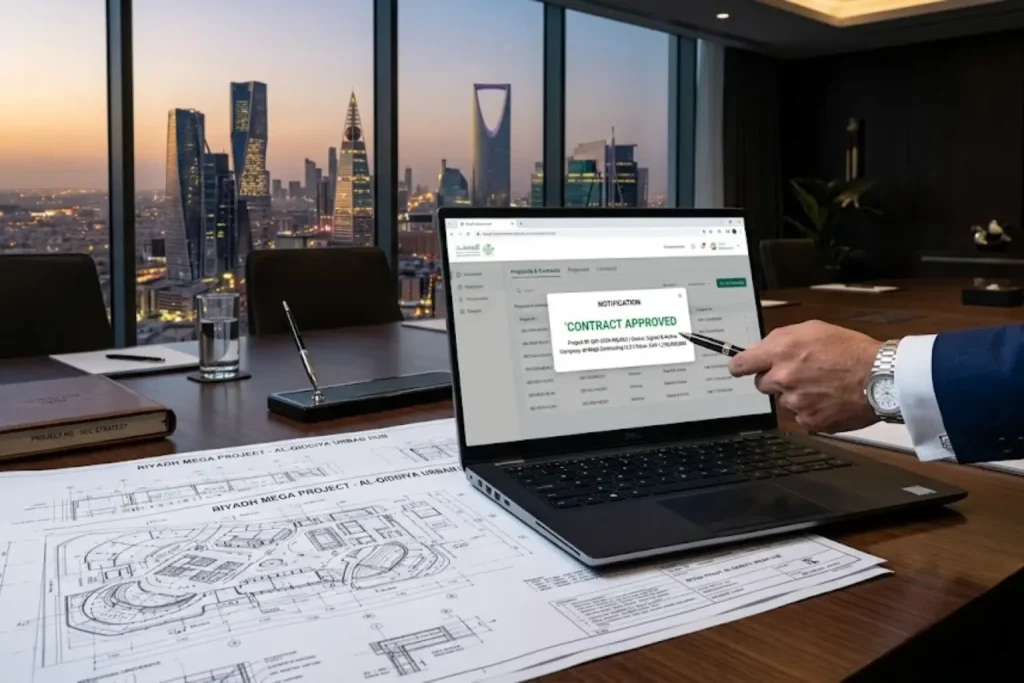
To understand the current state of Dubai vs Riyadh 2026, one must look at the “Regional Headquarters (RHQ) Mandate.” This Saudi government policy, which matured significantly in early 2024 and was refined with new exemptions in February 2026, dictates that any multinational company seeking to bid on Saudi government contracts or work with PIF-backed entities must have its regional headquarters in the Kingdom.
The Evolution of the RHQ Rule in 2026
By early 2026, the Saudi government introduced a formal “Exemption Mechanism” through the Etimad platform. This allows specialized firms—those providing niche technical expertise or offering costs 25% lower than competitors—to bid without an RHQ under strict conditions. However, for 90% of mid-to-large enterprises, the mandate remains absolute. If you want a slice of the USD 3 trillion Vision 2030 pipeline, your physical presence in Riyadh is mandatory.
The “Dual-Hub” Solution
Strategic leaders are not moving out of Dubai; they are moving into Riyadh. In the Dubai vs Riyadh 2026 paradigm, the UAE remains the center for regional treasury, global logistics, and executive talent retention, while Riyadh becomes the “Project Command Center.”
Infrastructure & Operational Readiness
When comparing Dubai vs Riyadh 2026, the physical reality of doing business is the first major hurdle.
Dubai: The Mature Global Gateway
Dubai remains the gold standard for “Plug-and-Play” business. With the expansion of Al Maktoum International Airport (DWC) and the continued dominance of DIFC and ADGM, the UAE offers a legal and physical infrastructure that is decades ahead.
- Speed to Market: You can set up a company in Dubai in 7 to 10 days.
- Connectivity: Over 100 airlines connect DXB to every major global market.
Riyadh: The Emerging Mega-Metropolis
Riyadh is a city under construction. While it lacks the immediate “ready-made” feel of Dubai, its growth is unparalleled.
- Supply Chain Squeeze: In 2026, Grade-A office space in Riyadh’s King Abdullah Financial District (KAFD) is at a premium.
- Lifestyle Maturity: While Riyadh has introduced high-end dining and entertainment, it still trails Dubai in terms of “Expat Comfort” and family-centric amenities.
3. The 2026 Fiscal Comparison: Tax and Incentives
The financial math of Dubai vs Riyadh 2026 requires a sharp eye on Corporate Tax (CT) and Zakat.
| Feature | UAE (Dubai/Abu Dhabi) | Saudi Arabia (Riyadh) |
| Standard Corporate Tax | 9% (on profits > AED 375k) | 20% (on foreign-owned profits) |
| RHQ Incentives | 0% in specific Free Zones | 30-Year Tax Holiday (0% CT) |
| VAT | 5% | 15% |
| Personal Income Tax | 0% | 0% |
The Saudi “Carrot”: 30-Year Tax Holiday
To win the Dubai vs Riyadh 2026 battle for capital, the Saudi Ministry of Investment (MISA) offers a 30-year 0% corporate income tax rate for companies that meet the RHQ criteria. This is a massive long-term incentive that often outweighs the higher operational costs of the Kingdom.
Talent War: Recruitment & The “Lifestyle Gap”
The most significant friction point in Dubai vs Riyadh 2026 is people. Top-tier global talent often prefers the liberal, cosmopolitan lifestyle of Dubai.
The “Hardship” vs. “Opportunity” Narrative
In 2026, Riyadh is no longer considered a “hardship post,” but it is still a “transition post.”
- The Dubai Edge: High-quality schooling, beachfront living, and a 90% expat population make it an easy sell for recruitment.
- The Riyadh Edge: Being at the “center of the action.” For ambitious professionals, Riyadh in 2026 is what Shanghai was in the 90s—the place where history is being made.
Saudization vs. Emiratization
Both nations are pushing for localization.
- Saudization: Strict and often mandatory for specific sectors.
- Emiratization: Generally more focused on the private sector via the Nafis program, with slightly more flexibility for smaller firms.
Legal Certainty: Common Law vs. Civil Law
For the C-suite, the “Rule of Law” is the ultimate decider in Dubai vs Riyadh 2026.
DIFC and ADGM: The Common Law Shield
The UAE’s greatest asset is its “islands of Common Law.” The DIFC and ADGM operate under their own independent, English-language courts. For international investors, this provides a level of certainty that is unmatched in the region.
The Saudi Transformation
Saudi Arabia is rapidly modernizing its legal system. However, it remains primarily a Civil Law jurisdiction rooted in Sharia principles. While the “New Investment Law” of 2025/2026 has significantly strengthened investor protections, many still prefer to hold their parent assets in a UAE Common Law “wrapper” while operating a branch in Riyadh.
Practical Strategy: The 2026 “Bridge” Model
If you are weighing Dubai vs Riyadh 2026, the most successful corporate model we see at Al Sahab Wadi Corporate is the “Bridge Model.”
- UAE Parent/HoldCo: Incorporate in ADGM or DIFC to own the intellectual property and hold the primary capital.
- KSA RHQ: Establish a Regional Headquarters in Riyadh with the mandatory 15 senior staff to satisfy the government mandate and secure the 30-year tax holiday.
- Cross-Border Mobility: Use the new “Unified GCC Visa” (launched in 2025/2026) to allow your senior management to move seamlessly between the two hubs.
Conclusion: No Longer a Choice, But a Synergy
The debate over Dubai vs Riyadh 2026 has reached a mature conclusion: The Middle East is large enough for two superstars. Dubai will remain the region’s “Front Office” and “Lifestyle Capital,” while Riyadh is cementing its status as the “Industrial and Project Powerhouse.”
Success in 2026 depends on your ability to walk the tightrope between these two giants. Do not choose a side; choose a structure that captures the best of both.
Frequently Asked Questions (FAQs)
Is the Saudi RHQ mandate strictly for companies with government contracts?
Technically, yes. However, many private-sector “Mega Projects” (like NEOM or Red Sea Global) are government-funded, making the RHQ effectively mandatory for anyone wanting to work on the Kingdom’s biggest developments.
Can I keep my family in Dubai while I work in Riyadh?
This is the most common executive lifestyle in 2026. Thanks to the 55-minute flight and the Unified GCC Visa, many executives commute weekly, keeping their families in Dubai for the schools and social infrastructure.
How does the 9% UAE Corporate Tax affect my Saudi operations?
If your UAE entity owns your Saudi branch, you must carefully navigate “Double Taxation Agreements.” Generally, tax paid in KSA can often be credited against UAE liabilities, but professional tax structuring is essential.
Which city is more expensive for business setup in 2026?
Riyadh is currently more expensive when factoring in the cost of Grade-A office space and the higher “Saudization” labor costs. Dubai offers a wider range of “entry-level” options and free zones.
Will Riyadh eventually replace Dubai as the regional hub?
Unlikely. The two cities are developing complementary strengths. Dubai’s status as a global transit and financial hub is deeply entrenched, while Riyadh is focused on becoming a localized production and G2G (Government-to-Government) center.
