

GCC Holding Company 2026: Structuring ADGM vs. DIFC for Regional M&A
In the high-stakes environment of Middle Eastern mergers and acquisitions, the choice of jurisdiction is the difference between a seamless exit and a decade-long legal quagmire. As of 2026, the GCC Holding Company 2026 has emerged as the mandatory “wrapper” for any serious regional investment. Whether you are acquiring a tech startup in Riyadh, a logistics firm in Oman, or a manufacturing plant in Ras Al Khaimah, the “Onshore” civil law environment often lacks the flexibility required for complex shareholder agreements, drag-along rights, and tiered equity.
At Al Sahab Wadi Corporate, we specialize in shielding international capital through the UAE’s two financial powerhouses: the Dubai International Financial Centre (DIFC) and the Abu Dhabi Global Market (ADGM). This briefing deconstructs the mechanics of the GCC Holding Company 2026, providing a surgical comparison to help you decide where to anchor your regional empire.
The Anatomy of a GCC Holding Company 2026
A GCC Holding Company 2026 is not an operational business; it is a legal fortress. Its sole purpose is to own shares in other companies (subsidiaries), hold intellectual property, and manage the flow of dividends and capital across borders.
The Problem with Onshore Structuring
Historically, investors held GCC assets directly in their own names or through Mainland LLCs. However, Mainland UAE or Saudi law is based on Civil Law principles, which often struggle to recognize common M&A tools like “alphabet shares” or specific vesting schedules for founders.
Why 2026 Demands a Common Law Wrapper
By 2026, international private equity firms and venture capitalists almost exclusively demand a GCC Holding Company 2026 based in a Common Law jurisdiction. This ensures that any dispute is handled in English, by judges familiar with global financial standards, and according to precedents that mirror the UK or Delaware courts.
The Neutrality of the UAE for Regional Play
The UAE has positioned itself as the “Switzerland of the Middle East.” Using a UAE-based GCC Holding Company 2026 to own assets in Saudi Arabia or Qatar provides a layer of political and legal neutrality that is highly prized by global LPs (Limited Partners).
ADGM: The Direct English Law Challenger
The Abu Dhabi Global Market (ADGM) has rapidly become the preferred choice for a GCC Holding Company 2026 due to its unique legislative “Short-Cut.”
Direct Application of English Common Law
Unlike other jurisdictions that “model” their laws on English principles, ADGM directly applies English Common Law. This means that if a case has been decided in London, it carries immediate weight in Abu Dhabi. For a GCC Holding Company 2026, this provides a level of legal predictability that is essentially unrivaled in the MENA region.
The Rise of the ADGM SPV
The Special Purpose Vehicle (SPV) is the “brick” used to build a GCC Holding Company 2026 portfolio. In 2026, ADGM has streamlined this process to be entirely digital, allowing for rapid incorporation without the need for physical office space, provided a Corporate Service Provider (CSP) is engaged.
Restricted Scope Companies (RSC) for Private Equity
For family offices and private equity sponsors who value discretion, ADGM offers the Restricted Scope Company. This specific type of GCC Holding Company 2026 allows for limited public disclosure of shareholders, providing an added layer of privacy for high-net-worth investors.
DIFC: The Established Global Tier-1 Hub
While ADGM is the “agile challenger,” the Dubai International Financial Centre (DIFC) remains the “Gold Standard” for institutional-grade GCC Holding Company 2026 structures.
The Depth of the Ecosystem
DIFC is home to the world’s largest banks and law firms. When you structure a GCC Holding Company 2026 in DIFC, you are placing your assets in an ecosystem with over 20 years of proven stability.
Independent DIFC Courts and Arbitration
DIFC operates its own independent judicial system. For a GCC Holding Company 2026, the DIFC-LCIA (and now DIAC) arbitration frameworks provide a globally recognized mechanism for resolving shareholder disputes without ever stepping foot in a local civil court.
Access to Institutional Capital
If your GCC Holding Company 2026 strategy involves an eventual IPO on the Nasdaq Dubai or attracting investment from Tier-1 global banks, the DIFC “brand” carries a level of prestige that simplifies due diligence and speeds up bank onboarding.
Financial Mechanics: Tax, Dividends, and Capital Gains
A GCC Holding Company 2026 is a fiscal tool as much as a legal one. Navigating the 2026 tax landscape is critical for maximizing your Net Internal Rate of Return (IRR).
The 9% Corporate Tax and the “Holding” Exemption
The UAE’s 9% Corporate Tax, fully implemented by 2026, includes a vital “Participation Exemption.” Under this rule, a GCC Holding Company 2026 may be exempt from tax on dividends and capital gains derived from its subsidiaries, provided certain ownership thresholds and holding periods are met.
Repatriation of Profits
A major advantage of the GCC Holding Company 2026 is the total lack of withholding taxes on the repatriation of profits to the parent company or shareholders abroad. This makes the UAE a perfect “conduit” for regional profits.
Treaty Benefits: The Power of 140+ Agreements
The UAE has signed over 140 Double Taxation Agreements (DTAs). By using a GCC Holding Company 2026, investors can often reduce or eliminate withholding taxes on dividends flowing from subsidiaries in countries like Saudi Arabia or Egypt back to the UAE.
M&A Readiness: Share Classes and Governance
The true power of a GCC Holding Company 2026 is revealed during a transaction.
Multi-Class Share Structures
In a typical M&A deal, you might have “Class A” shares for founders (with 10x voting rights), “Class B” for investors (with liquidation preference), and “Class C” for employees (options). A GCC Holding Company 2026 in ADGM or DIFC allows for this level of granular complexity, which is virtually impossible in a standard Mainland LLC.
Drag-Along and Tag-Along Rights
In 2026, the UAE Federal Companies Law has modernized, but the GCC Holding Company 2026 in a financial center still offers the most robust enforcement of “Drag-Along” rights. If 75% of shareholders want to sell the company, they can legally force the minority 25% to join the deal, preventing a single minority shareholder from “holding the deal to ransom.”
Managing Regional Subsidiaries
The GCC Holding Company 2026 acts as the central brain. It can provide inter-company loans to a subsidiary in Riyadh, hold the global IP for a franchise in Qatar, and manage the regional payroll from Dubai, all while keeping the ultimate liability centralized and ring-fenced.
Strategic Comparison: Which One to Choose?
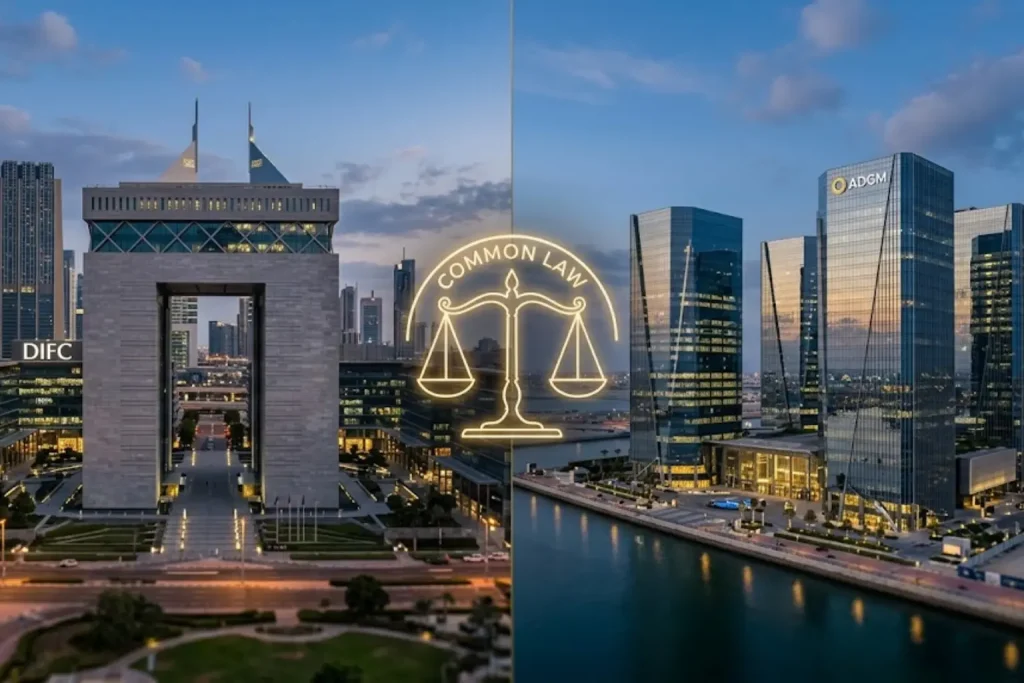
While both are excellent, the choice between ADGM and DIFC for your GCC Holding Company 2026 often comes down to your “Center of Gravity.”
| Factor | ADGM (Abu Dhabi) | DIFC (Dubai) |
| Legal Basis | Direct English Common Law | Codified Common Law |
| Setup Cost | Generally ~20-30% lower | Higher, reflecting “Gold Standard” status |
| Speed to Market | Highly digital, very fast (3-5 days) | Thorough but slightly more administrative |
| Primary Audience | Tech, VC, Crypto, Sovereign Wealth | Banks, Insurance, Asset Managers |
When to Choose ADGM
Choose ADGM for your GCC Holding Company 2026 if you are an agile startup, a family office seeking a foundation, or if your primary investment relationships are with Abu Dhabi-based sovereign wealth funds like Mubadala or ADQ.
When to Choose DIFC
Choose DIFC for your GCC Holding Company 2026 if you require the highest level of institutional prestige, need to be physically surrounded by global investment banks, or are planning a large-scale regional exit via a public listing.
Conclusion: The Shield of the Strategic Investor
Expansion without a “wrapper” is exposure. In the volatile but lucrative markets of the Middle East, the GCC Holding Company 2026 is your most important asset. It provides the legal certainty of London, the tax efficiency of the UAE, and the operational agility required to dominate the region from Kuwait to Muscat.
At Al Sahab Wadi Corporate, we don’t just set up companies; we build the legal architecture of your legacy.
Frequently Asked Questions (FAQs)
Can a GCC Holding Company 2026 own property in Dubai or Abu Dhabi?
Yes. Both ADGM and DIFC have agreements with the respective Land Departments allowing their holding companies to own freehold real estate, provided the ultimate beneficial owners meet the nationality requirements for the specific area.
Do I need a physical office for my GCC Holding Company 2026?
In ADGM, “Special Purpose Vehicles” (SPVs) do not require physical offices and can use their CSP’s address. In DIFC, most holding companies are required to have at least a “Flexi-Desk” or a small physical presence, though regulations for “Prescribed Entities” have become more flexible.
How does “Economic Substance” (ESR) apply to a holding company?
In 2026, “Pure Equity Holding Companies” are subject to a lower level of Economic Substance requirements. You must demonstrate that you have adequate people and premises (which can be provided by your service provider) to manage the holding activity.
Can I use my GCC Holding Company 2026 to open a corporate bank account in Europe?
Yes. Because ADGM and DIFC are “Whitelisted” and follow international AML/KYC standards, banks in the UK, Switzerland, and Singapore generally accept these entities far more easily than “Offshore” islands like the BVI or Cayman.
Is it possible to migrate an existing BVI or Cayman company to a GCC Holding Company 2026?
Absolutely. Both ADGM and DIFC allow for “Continuance” (Redomiciliation). You can move your existing international company into the UAE without dissolving the legal entity, preserving its history and contracts.
